
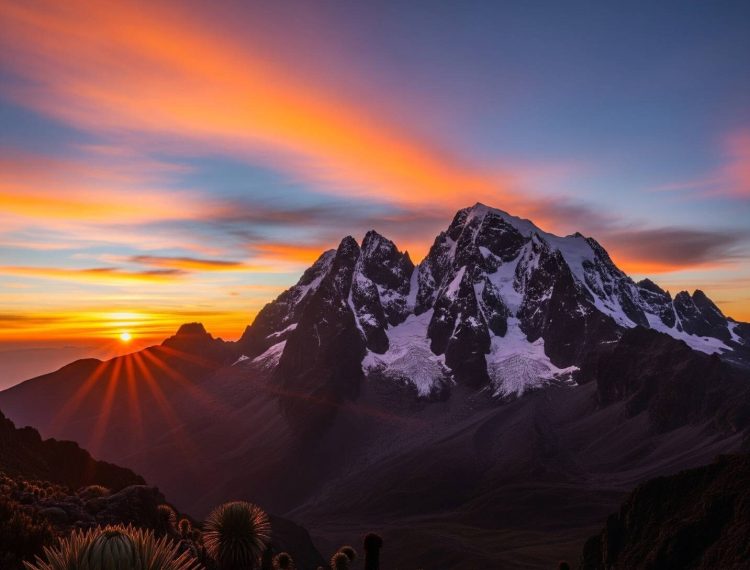
Climp Mount Kenya
Summit
Mount Kenya.
Where Every Journey Echoes Africa’s Beauty!
While trekking to Point Lenana is a challenging hike, the true summit peaks of Mount Kenya (Batian and Nelion) are technical climbs that demand specialized equipment and advanced climbing skills.
Mount Kenya National Park is situated east of the Great Rift Valley, roughly 175 km northeast of Nairobi. The park’s ecosystem spans Kenya’s Central and Eastern provinces.
At 5,199 meters, Mount Kenya is the second-highest peak in Africa. It’s a critical water source, supplying about half of Kenya’s population and generating 70% of the country’s hydroelectric power
The Sirimon route offers a more gradual ascent to the summit. It is a popular choice, especially for those new to high-altitude trekking, as it’s generally considered the easiest of the shorter trips.
This trek takes you through lush forests before opening up into vast moorlands. It’s a great option for larger groups because the trail is the same for the ascent and descent, allowing hikers who don’t reach the summit to wait at lower camps and rejoin the group later.
Along the route, you’ll find mountain huts and a lodge, so camping isn’t necessary unless you prefer it.
The Chogoria traverse is widely considered the ultimate trek on Mount Kenya. This route takes you to Point Lenana, the trekker’s peak at 4,985 meters, even though the mountain’s highest point is 5,199 meters.
The traverse begins at the Sirimon Gate, leading you to Point Lenana, then descends via the Chogoria route to the Chogoria Gate. This journey typically takes five to six days.
You’ll ascend using the popular and scenic Sirimon route. The descent is what makes this trek so special, as the Chogoria route is arguably the most stunning on the mountain, featuring dramatic gorges, beautiful tarns, and cascading waterfalls. The total distance is 60 km, with a total elevation change of 2,400 meters.
The Naro Moru traverse is the most popular trekking route on Mount Kenya, and for good reason. It offers a balanced climb and a swift descent, starting with a steady ascent up the Sirimon route and a quick return via the Naro Moru route.
While this route doesn’t cover all of Mount Kenya’s features, it is incredibly scenic. You’ll pass through the expansive Mackinder’s Valley, head toward Shipton’s Camp, and descend through the challenging “vertical bog” and thick rainforest on the way down. The full traverse is just under 60 km and involves a total elevation change of 2,400 meters.
Mount Kenya’s climate is cold year-round due to its small, rapidly disappearing glaciers. At higher altitudes, nighttime temperatures can plummet to as low as -10°C (14°F).
Mornings on the mountain are typically sunny and dry, with clouds often forming around midday. While it’s possible to hike Mount Kenya throughout the year, trekking becomes more challenging during the rainy seasons, which run from mid-March to mid-June and from October to mid-December.